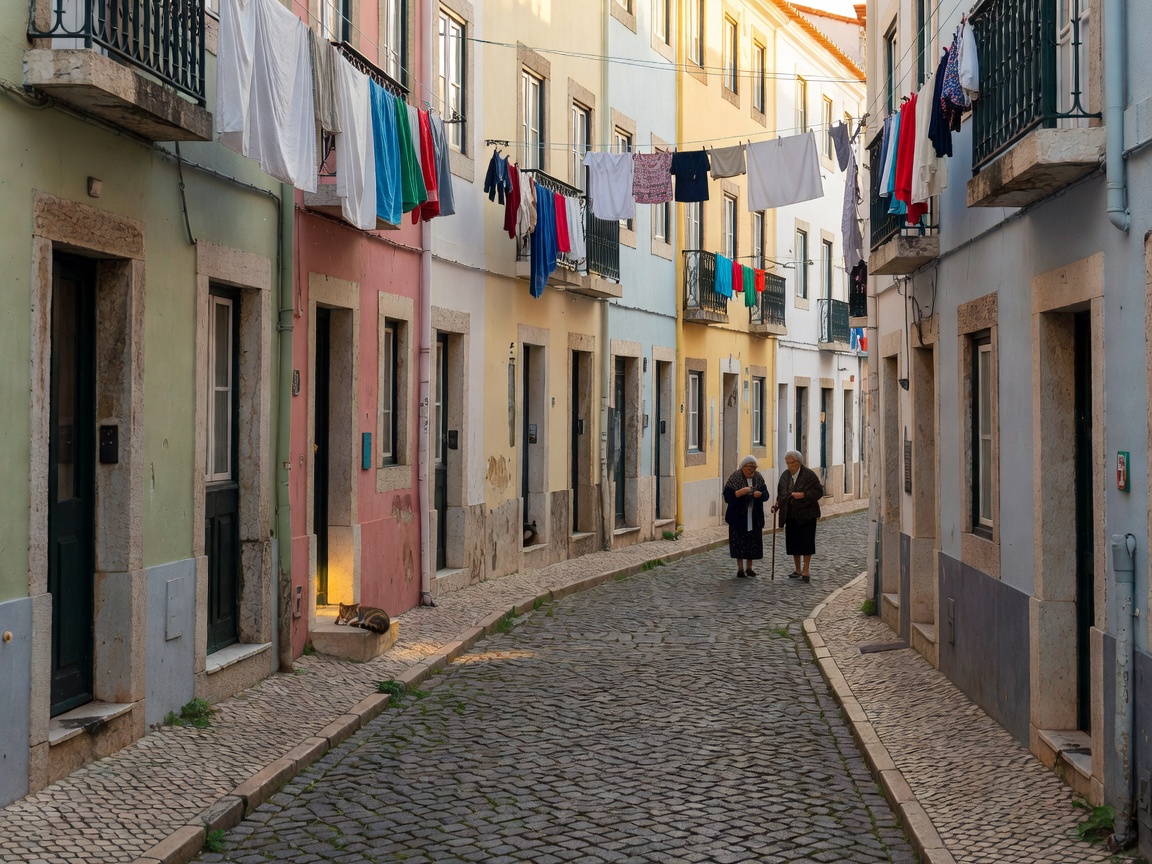
The Medieval Fabric: Alfama, Castelo & Mouraria
Lisbon’s historic core is an exercise in topographical endurance. While the lower Baixa district was completely reconstructed along a rational Enlightenment grid after the 1755 earthquake by the Marquis of Pombal, the eastern slopes of Alfama and Mouraria preserve an uninterrupted medieval footprint. Here, tight staircases (escadinhas), archways, and blind alleys wind upward toward the ramparts of Castelo de São Jorge.
Alfama originated under Moorish rule as an administrative and residential settlement outside the citadel walls, famed for natural thermal springs (al-hamma, giving the quarter its name). Walking through the district requires sturdy footwear to negotiate the polished limestone calçada, which becomes famously slick in humid sea mists. Morning hours (07:30 to 10:00) offer quiet solitude before tour crowds converge on Tram 28, revealing local neighborhood life centered around community fountains, grocers, and quiet taverns.
"The light of Lisbon is defined by reflection: Atlantic sun striking the pale Tagus estuary, mirrored upward onto pastel facades and the crystalline limestone cobbles underfoot."
The Miradouro Circuit: Lisbon From Above
Because Lisbon is founded on dramatic topographical ridges, viewpoints (miradouros) function as civic living rooms. Understanding the distinctive perspective of each viewpoint is essential to planning an efficient traverse of the city:
- Miradouro das Portas do Sol: The classic eastern panorama overlooking the terracotta roofs of Alfama, the church towers of São Vicente de Fora, and cruise vessels navigating the deep shipping channel of the Tagus.
- Miradouro de Santa Luzia: Positioned adjacent to Portas do Sol, framed by bougainvillea pergolas and intricate blue azulejo panels depicting Praça do Comércio before the 1755 disaster.
- Miradouro da Senhora do Monte: The highest public viewpoint in Graça, providing an unobstructed 270-degree view spanning the Castle, downtown Baixa, the 25 de Abril suspension bridge, and the Monsanto forest park. Ideal for sunset observations.
- Miradouro de São Pedro de Alcântara: Anchoring the western ridge in Bairro Alto, overlooking the valley floor toward the Castle and Graça hill. A terraced garden adorned with classical busts and tile maps detailing the skyline.
Belém and the Monumental Maritime Axis
Six kilometres west along the estuary lies Belém, the symbolic launching pad of Portugal's 15th- and 16th-century maritime expeditions led by Vasco da Gama and Pedro Álvares Cabral. The district is characterized by expansive riverfront esplanades and the zenith of Manueline (Portuguese late Gothic) stonecraft.
The centerpiece is Mosteiro dos Jerónimos, commissioned by King Manuel I in 1501 and funded largely by the spice commerce from the Indian Ocean. Its cloisters represent one of the crowning artistic achievements of European stonemasonry, adorned with nautical instruments, exotic foliage, sea monsters, and delicate colonnettes sculpted from lioz limestone. Adjacent to the monastery sits the maritime fortress of Torre de Belém, an isolated tower built in the stream of the Tagus to defend the harbor entrance.
Lisbon Advantages
- Extraordinary pedestrian viewpoints integrated into public plazas.
- World-class public transit, including historic funiculars and modern metro.
- Rich culinary heritage focusing on fresh Atlantic seafood and salt cod (bacalhau).
- Proximity to Atlantic surf beaches and Sintra's natural parks.
Logistical Realities
- Steep gradients can be challenging for travelers with mobility limitations.
- Tram 28 and major Belém monuments experience severe queues during peak daylight.
- Limestone cobbles require footwear with high-traction soles.
- Summer midday temperatures regularly surpass 34°C in enclosed stone alleys.
Practical Transit & Itinerary Structuring
To avoid midday congestion and heat, structure visits chronologically. Reserve early mornings for uphill exploration of Alfama and the Castelo quarter before cruise tour groups disembark. Midday is best spent inside climate-tempered interiors such as the Museu Nacional do Azulejo (National Tile Museum) housed in the Convent of Madre de Deus. Schedule Belém for either the first entry slot at 09:30 or late afternoon when tour buses depart toward suburban hotels.
Avoid relying solely on historic Tram 28 for functional transit; use the modern metro network or suburban commuter rail lines (Linha de Cascais) for fast travel along the riverbank corridor.