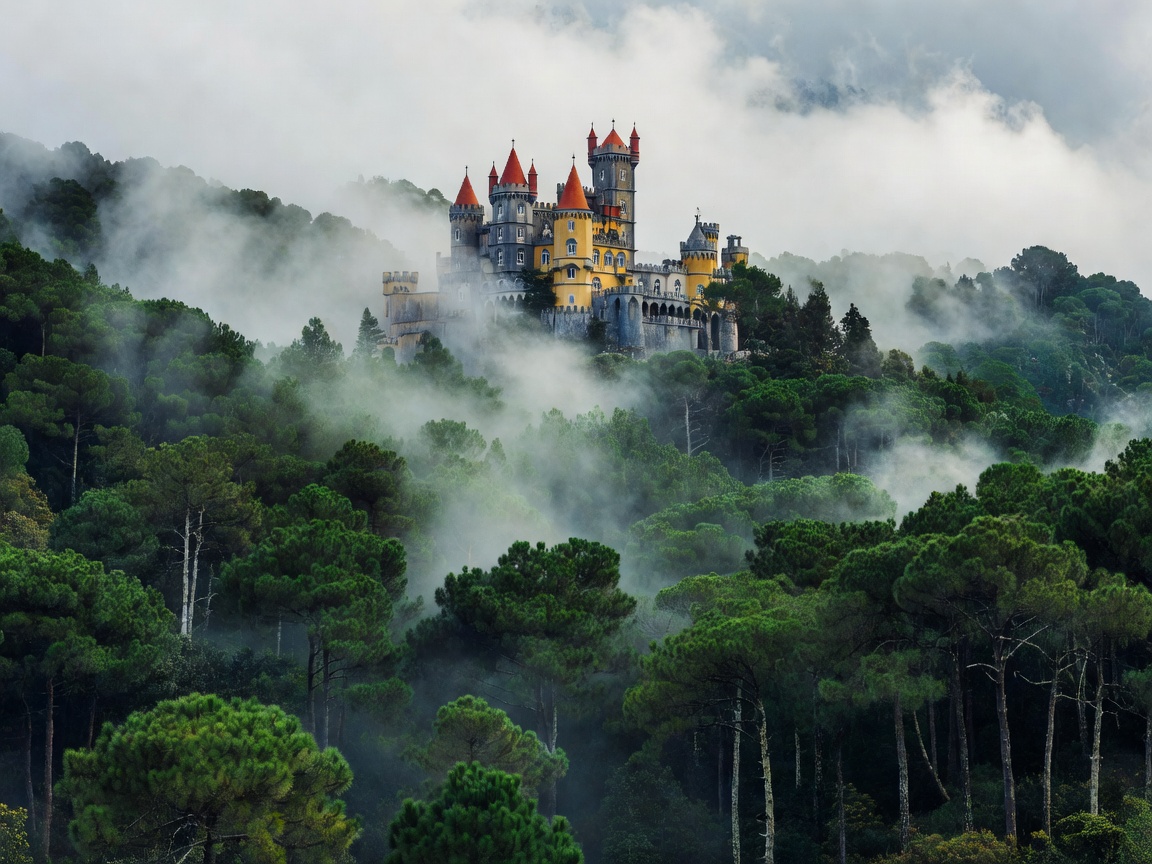
The Microclimate & Botanical Landscape
The Serra de Sintra constitutes a unique geological granite intrusion that acts as a climatic barrier against moisture-laden Atlantic air masses. While Lisbon, just 30 kilometers east, may experience scorching 35°C summer conditions under bright sun, Sintra is frequently engulfed in cool, swirling fog banks with temperatures up to ten degrees lower.
This constant moisture enabled 19th-century royal landscapers and botanists to establish expansive arboretums combining flora from every continent. Tree ferns from New Zealand and Tasmania, North American redwoods, Himalayan cedars, and Japanese camellias flourish beneath colossal granite boulders, creating an almost mythical forest environment.
Architectural Crown Jewels: Pena, Regaleira & Monserrate
Sintra is celebrated for its dense concentration of unique estates, each representing a different aspect of 19th-century Romantic thought:
- Palácio Nacional da Pena: Designed by King Consort Ferdinand II and German architect Wilhelm Ludwig von Eschwege atop the ruins of a Hieronymite monastery. It merges Neo-Manueline, Neo-Gothic, Neo-Islamic, and Renaissance decorative motifs painted in vivid yellow, terra cotta, and purple tones.
- Quinta da Regaleira: Conceived by eccentric businessman António Augusto Carvalho Monteiro and Italian opera set designer Luigi Manini. The four-hectare estate is an enigmatic garden filled with Masonic, alchemical, and Knights Templar symbolism, anchored by the famous 27-metre subterranean Initiatory Well (Poço Iniciático).
- Palácio de Monserrate: Commissioned by British merchant Francis Cook, showcasing Moorish, Indian, and Venetian architectural lines paired with one of the most meticulously designed botanical collections in the hemisphere.
- Castelo dos Mouros: An 8th- to 9th-century fortification perched along jagged granite crests, providing military lookouts across the entire Estremadura coastline.
"Lord Byron declared Sintra a 'glorious Eden' in 1809. Today, its mist-shrouded palaces and lush forested paths still evoke an otherworldly romantic melancholy."
Where the Land Ends: Cabo da Roca
Just fifteen kilometers west of Sintra’s historic town center lies Cabo da Roca, the westernmost promontory of continental Europe (38°47′N, 9°30′W). Here, the granite hills drop precipitously into crashing Atlantic rollers from 140-meter vertical sea cliffs.
The landscape shifts dramatically from dense, sheltered cloud forests to windswept maritime heath dominated by sour fig (carpobrotus edulis) and sea thrift. A visit to the historic 1772 lighthouse at sunset offers a stark reminder of Portugal's frontier position overlooking thousands of miles of unbroken ocean.
Why Sintra is Unmatched
- Concentration of European Romantic landscape architecture.
- Cooler summer microclimate providing refuge from city heat.
- Extensive network of forested hiking paths between estates.
- Direct 40-minute commuter train link from Lisbon's Rossio station.
Planning Obstacles
- Severe private vehicle restrictions; private cars are banned on mountain roads.
- Timed entry tickets for Pena Palace sell out days in advance during peak season.
- Dense afternoon fog can obscure panoramic views from the summits.
- High humidity requires layered clothing regardless of summer warmth in Lisbon.
Logistical Field Advice
Avoid day-tour coaches by taking the 07:41 or 08:11 train from Lisbon's Rossio directly to Sintra terminal. Pre-book the earliest entry slot (09:00 or 09:30) for Pena Palace, taking the 434 tourist bus or a licensed local ride up the mountain immediately upon arrival.
After touring Pena and the adjacent Moorish Castle, hike downward through the shaded forest trails rather than waiting in lengthy queue lines for buses. Dedicate your afternoon to Quinta da Regaleira and Monserrate, which experience significantly lighter crowd density.